
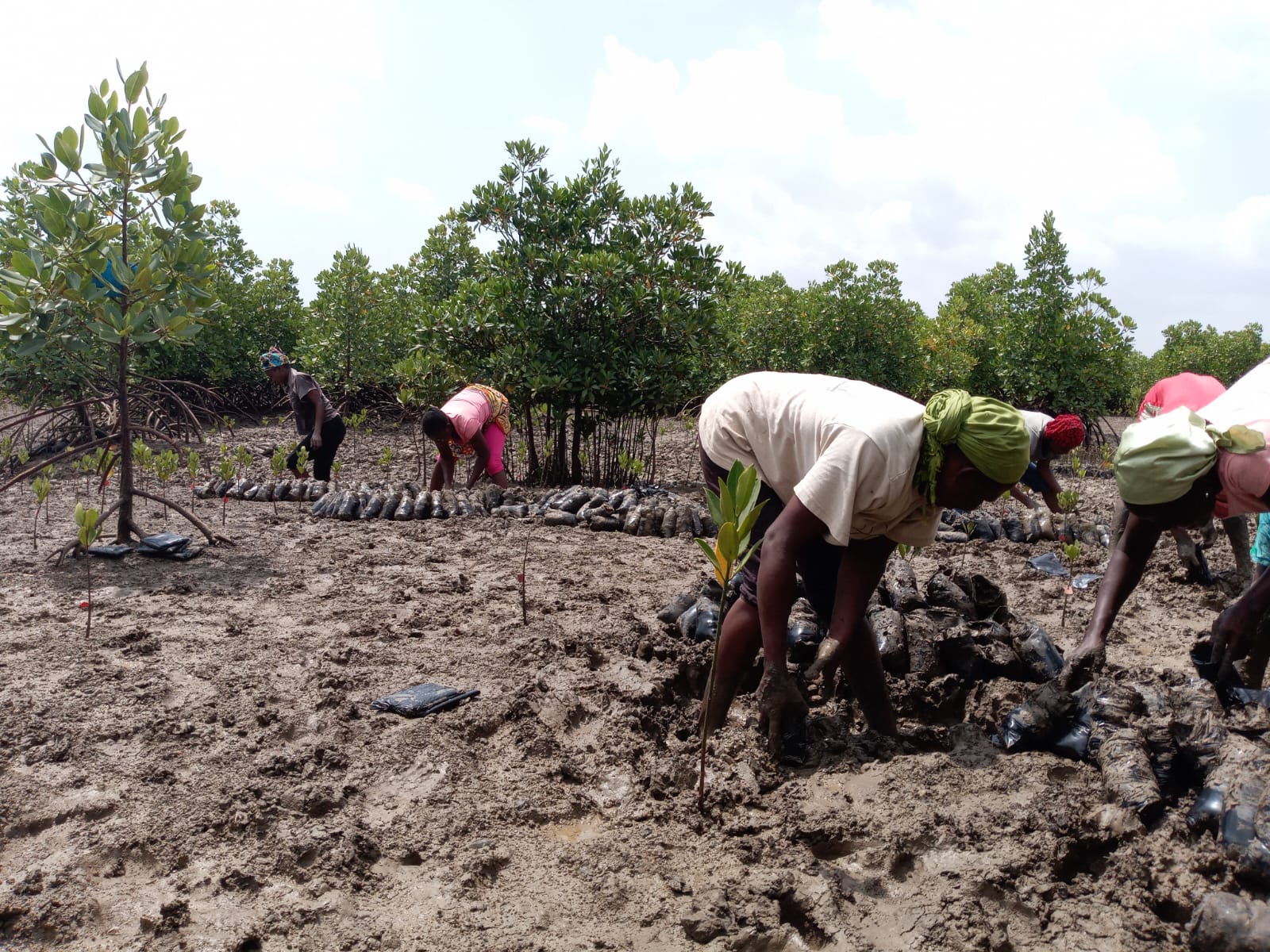

Monitoring of more than 100,000 mangrove seedlings established along the Tsunza Peninsula has provided important insights into the ecological and socioeconomic outcomes of a community-based mangrove restoration programme implemented by Marine Nature Conservation Organization (MNCO).
The monitoring exercise assessed mangrove seedling survival, documented natural regeneration and examined the community-based mechanisms used to protect restored areas. It also looked at how participation in the restoration programme had affected the livelihoods and household conditions of participating community members.
Monitoring Mangrove Restoration Progress
The monitoring exercise used a combination of permanent and random monitoring plots to assess the condition of restored areas.
Each monitoring plot covered a 2.5-metre radius. Permanent plots were established to allow the same areas to be monitored over time and provide information on changes in seedling survival. Random plots provided additional snapshots of conditions across the restoration sites.
The monitoring team classified seedlings and young mangroves into four categories:
- Live seedlings that had successfully established
- Dead seedlings that had not survived
- Dormant seedlings showing delayed establishment
- Naturally regenerating mangroves that had emerged without being directly planted
This approach allowed the monitoring exercise to distinguish between planting outcomes, delayed establishment and natural forest regeneration.
A 72% Mangrove Seedling Survival Rate
The monitoring recorded a 72% survival rate among the planted mangrove seedlings assessed.
This result provides an important measure of restoration performance and demonstrates that a substantial proportion of the seedlings established through the programme continued to survive within the monitored areas.
The results also provide a baseline for continued monitoring of the restored sites as the mangroves mature and ecosystem conditions change over time.
Natural Regeneration Adds to Restoration Gains
The monitoring exercise also recorded evidence of natural mangrove regeneration within the monitored plots.
The presence of naturally regenerating mangroves is significant because it indicates that restoration is not limited to the seedlings initially planted by the project. Where suitable ecological conditions exist, mangroves can begin regenerating naturally and contribute to the expansion and recovery of restored forest areas.
Continued monitoring will help establish how this natural regeneration develops alongside the planted mangroves.
Communities Supporting Mangrove Protection
Community participation has been an important part of protecting the restored areas.
A trained network of community forest scouts has been incorporated into the protection system. The scouts perform two key functions within the restoration sites.
Preventing Illegal Mangrove Cutting
Community forest scouts help monitor the restoration areas and prevent illegal cutting of mangroves. Their presence provides a local protection mechanism that can respond to threats within and around restored sites.
Raising Awareness Within the Community
The scouts also support community sensitisation on the ecological importance of mangroves.
By sharing information about the role of mangroves in supporting fisheries, biodiversity, coastal protection and local livelihoods, the programme extends conservation awareness beyond the immediate restoration team.
This community-based approach has helped create local ownership of the restoration sites while providing a practical mechanism for protecting young mangrove forests.
Restoration Supporting Local Households
The restoration programme has also generated economic opportunities for participating community members throughout different stages of implementation.
Income-generating activities have included nursery propagation, mangrove planting and monitoring, allowing community members to participate in restoration while earning income from project activities.
Monitoring of participating households also documented several socioeconomic changes.
Improved Access to Education
Participating households reported increased school enrolment among children, indicating improved access to education within beneficiary households.
Improved Housing Conditions
Some participating households transitioned from grass-thatched roofing to iron-sheet roofing, reflecting improvements in household living conditions.
Increased Access to Electricity
An increase in household electricity connections was also documented among participating households, providing an indicator of improved household infrastructure and energy access.
Emerging Small-Scale Businesses
Participation in the restoration programme has also been associated with greater economic diversification. Some participants have established small-scale agribusiness ventures, creating additional sources of household income beyond traditional livelihoods.
Fisheries and Food Security
Community members also reported an increase in fish abundance in adjacent waters.
For households that depend on fishing, changes in local fish availability can have direct implications for food security and household income. Continued ecological monitoring will be important for understanding the relationship between mangrove recovery and fisheries over the longer term.
Building on the Tsunza Peninsula Restoration Experience
The results from the Tsunza Peninsula provide useful evidence on the outcomes of combining mangrove restoration with community participation and long-term site protection.
With a 72% recorded seedling survival rate, evidence of natural regeneration, active community-based protection and documented socioeconomic outcomes among participating households, the project provides a foundation for continued monitoring and future restoration efforts.
The experience will also contribute to MNCO’s broader ambition of planting one million mangroves by 2027, with lessons from completed restoration activities helping inform the planning and implementation of future projects.